Bestway Supermart
Grocery Store Franchise vs Independent Grocery Store – Which is Better?

Opening a Grocery Store Franchise or opening an Independent Grocery Store is a big step for anyone who wants to enter the grocery retail business. However, despite the availability of funds and a suitable location, many people hesitate when they realize that they have to decide which of the two to choose. So what is the difference between a Grocery Store Franchise and an Independent Grocery Store?
The differences are significant, and the choice depends on many factors, including the capabilities of the future owner, their role in the development of the business, and even their plans for the future. Nevertheless, to weigh the pros and cons of each variant, let’s take a closer look at them.
Grocery Store Franchise vs Independent Grocery Store: Definition and Key Differences
A Grocery Store Franchise is a business model that provides an entrepreneur with an opportunity to run a grocery retail business under a well-known brand’s umbrella. In most cases, a franchise contract entitles the future owner to all the benefits provided by the franchisor, including the business plan, technology, processes, marketing, and more.
An Independent Grocery Store refers to a business model in which the entrepreneur is entirely responsible for their business. Such a store owner makes all the decisions about the goods on their own, independently selects the suppliers, sets up the store’s internal structure, develops and implements the marketing strategy, etc.
Thus, the key difference between an Independent Grocery Store and a Grocery Store Franchise lies in the fact that the former offers full control, while the latter implies the ability to rely on the help of an experienced franchisor.
Grocery Store Franchise: What You Know About Grocery Store Franchise?
A Grocery Store Franchise allows an entrepreneur to open a grocery retail store under an already well-known brand and use its benefits. In most cases, a franchisor provides a complete business plan, marketing tools, technology, know-how, and other services. A franchise contract usually relieves the future owner from worrying about the day-to-day running of the business and following strict rules set by the franchisor.
Therefore, a Grocery Store Franchise is ideal for those who, for one reason or another, do not want to be engaged in every detail of the business and prefer to follow ready-made instructions.
Independent Grocery Store: What You Know About Independent Grocery Store?
An Independent Grocery Store implies a complete absence of any affiliation between the owner and franchisors. The owner of such a store is entirely responsible for all aspects of the business: choosing goods, finding suppliers, setting prices, and developing and implementing marketing strategies.
Therefore, it is important to mention that an independent grocery store owner has full control over their business, which can be both an advantage and a disadvantage at the same time.
Grocery Store Franchise vs Independent Grocery Store: What Are the Main Differences?
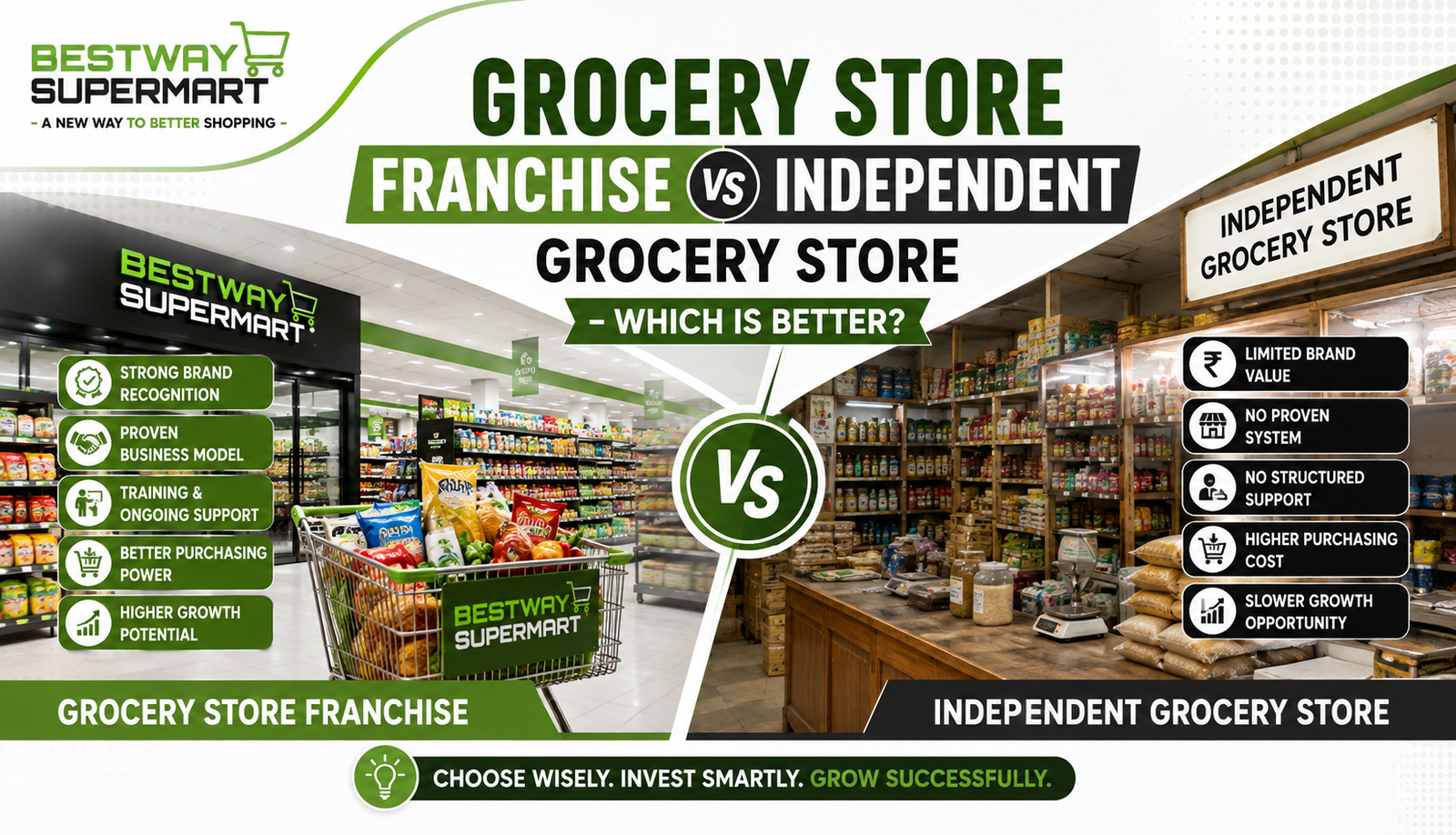
The main differences between an Independent Grocery Store and a Grocery Store Franchise include brand image, control, operating system, marketing, supplier base, product offerings, technology, training, expansion opportunities, and decision-making.
| Factor | Grocery Store Franchise | Independent Grocery Store |
|---|---|---|
| Brand Identity | The owner uses the known brand identity of the franchisor. | The brand image is built at the expense of the entrepreneur. |
| Business Control | The degree of control is moderate since the owner must adhere to the standards set by the franchisor. | The control is complete since all business decisions are made by the entrepreneur. |
| Operating System | Usually, a ready-made operating system is provided. | The entrepreneur is responsible for creating a concept and operating system. |
| Marketing | The franchisor provides the owner with marketing tools. | The owner is responsible for developing and implementing the marketing strategy. |
| Supplier Base | Usually, a wide range of suppliers is provided. | The entrepreneur must independently find the necessary suppliers. |
| Product Offerings | The product offerings are standardized. | The entrepreneur chooses what products to offer. |
| Technology | Most often, technology is provided. | The entrepreneur has the opportunity to choose technology. |
| Training | Usually, training is provided. | The entrepreneur must independently train the staff. |
| Expansion Opportunities | The expansion opportunities are provided at the franchisor’s expense. | The entrepreneur must independently expand the business. |
| Decision-Making | Most often, important decisions are made by the franchisor. | The entrepreneur makes all the decisions. |
Independent Grocery Store: Pros and Cons
Advantages of an Independent Grocery Store
- Complete Control: The owner has complete control over business decisions.
- Flexibility of Options: The owner can make decisions according to local demand.
- Wide Range of Product Offerings: Products can be selected according to customer requirements.
- Ability to Set Prices: The owner can decide the pricing strategy.
- Creation and Promotion of Brand Image: The owner can build a unique brand identity.
Disadvantages of an Independent Grocery Store
- Complete Responsibility: The owner is responsible for all business decisions.
- Product and Pricing Challenges: It may be difficult to decide which products to offer and establish prices.
- Supplier Management: The choice of suppliers may require significant effort.
- High Personal Involvement: A high level of personal involvement may be required.
- Brand Building Takes Time: It may take time to find customers and develop the brand.
Grocery Store Franchise: Pros and Cons
Advantages of a Grocery Store Franchise
- Reputation and Brand Image: The franchise benefits from an established brand identity.
- Ready-Made Business Plan: A structured business plan may already be available.
- Assistance in Project Implementation: The franchisor may assist with business setup.
- Wide Range of Product Offerings: A broad product range may be available.
- Wide Range of Suppliers and Technologies: Franchisees may benefit from established supplier networks and technology.
- Marketing and Advertising Support: The franchisor may provide marketing and advertising assistance.
Disadvantages of a Grocery Store Franchise
- Limited Personalization: There may be limited opportunities for customization.
- Lack of Complete Control: The owner has to follow the franchisor’s guidelines.
- Restrictions: Certain restrictions may be imposed by the franchisor.
- Royalty Fees: Some franchise models may involve high royalty fees.
- Competition: Competition can be high.
- Support May Vary: Some franchisors may provide insufficient support.
Grocery Store Franchise vs Independent Grocery Store: Comparison and Contrast
Pros of an Independent Grocery Store
The independent store has one major advantage and disadvantage at the same time – full control. The owner makes all the decisions, whether it is choosing which products to offer or setting prices. At the same time, creating an independent brand image and promoting it may take much effort and time.
On the other hand, the Grocery Store Franchise has the advantage that it provides the entrepreneur with full support in setting up the business. Even more importantly, the franchisor has an already working brand image and knows exactly how to promote it.
In addition, a wide range of product offerings, technology, and other benefits may be provided. Of course, in exchange for these advantages, the entrepreneur must give up some control and follow all the requirements set by the franchisor.
Grocery Store Franchise vs Independent Grocery Store: What Influences the Choice?
Some factors are decisive when comparing the differences between choosing a Grocery Store Franchise and an Independent Grocery Store. These include:
- The size of the investment
- The level of responsibility and involvement
- The concept and target customer
- The degree of control
- Experience
- The ability to expand the business
Grocery Store Franchise vs Independent Grocery Store: Investment Comparison
It is the size of the investment that is most often the decisive factor when comparing an Independent Grocery Store and a Grocery Store Franchise.
On the one hand, an independent store owner does not have to pay monthly or annual fees to the franchisor. On the other hand, it is the independent store owner who has to invest in creating and promoting their own brand, accumulating a base of suppliers, setting up all the necessary equipment, and much more.
Therefore, this factor should be considered with caution.
Grocery Store Franchise vs Independent Grocery Store: Brand Image
The brand image is another factor that plays a significant role in distinguishing between an Independent Grocery Store and a Grocery Store Franchise.
While the independent store owner must build a brand image from scratch, the franchisor will take care of this issue with the Grocery Store Franchise.
Therefore, in the case of a Grocery Store Franchise, a ready-made concept, advertising, and even a design will be provided, which is certainly a big advantage.
At the same time, the independent store owner will have to invest time and effort in the process of building the brand image.
Grocery Store Franchise vs Independent Grocery Store: The Degree of Control
The degree of control is perhaps the most controversial of all the aspects of differences between an Independent Grocery Store and a Grocery Store Franchise.
An independent store owner is fully responsible for all aspects of the business, which may seem overwhelming for someone who is just getting started. On the other hand, the owner of the independent store has complete control, which, in theory, should mean more opportunities for profit.
However, in the case of a Grocery Store Franchise, the situation is exactly the opposite: the franchisor has some restrictions, but the entrepreneur has more opportunities for earning.
Grocery Store Franchise vs Independent Grocery Store: Experience
Experience, or rather the lack thereof, is another factor that differentiates between the Independent Grocery Store and Grocery Store Franchise options.
If the entrepreneur has previous experience in the retail business, independent ownership will probably be much better for them since they will not have to deal with the intricacies of creating a business concept from scratch.
On the contrary, a Grocery Store Franchise will be the best option for rookie entrepreneurs who need to build their business experience.
Grocery Store Franchise vs Independent Grocery Store: Expansion Opportunities
When comparing an Independent Grocery Store and a Grocery Store Franchise, the issue of the potential for expansion should also be discussed.
While the independent store owner will have to develop their own business plan for expansion, the franchisor will provide the entrepreneur with a wide range of opportunities to promote their brand.
At the same time, it should be noted that most franchisors offer various options for the expansion of the business, which allows the entrepreneurs to choose the most cost-effective and convenient one for them.
Independent Grocery Store or Grocery Store Franchise: Which to Choose?
There is no ultimate answer to the question of which of the two variants is more advantageous: an Independent Grocery Store or a Grocery Store Franchise.
However, we can list the advantages and disadvantages to see which option is currently more beneficial for the entrepreneur.
Who Should Open an Independent Grocery Store?
An Independent Grocery Store is best suited for those who want complete control and are ready to carry all responsibilities.
Besides, such a business is more cost-effective in the long run since no fees are paid to the franchisor. Moreover, the independent store owner has complete freedom of choice of suppliers, products, and other aspects of the business.
Who Should Open a Grocery Store Franchise?
A Grocery Store Franchise is ideal for those who want to be their own boss but do not want to deal with the daily running of the business.
In addition, such a business model provides an entrepreneur with many opportunities, from a ready-made concept to extensive marketing support.
Finally, the franchisor may also provide the owner with valuable technologies and know-how.
Independent Grocery Store or Grocery Store Franchise: Which One to Choose?
Before choosing between an Independent Grocery Store and a Grocery Store Franchise, it is vital to compare the two options, taking into account the available financial resources, previous experience, and plans for the future.
Each of the two variants has many advantages and disadvantages that should be carefully considered. Moreover, every entrepreneur should understand that choosing the most cost-effective option is not always the best idea.
Thus, an independent store may seem like a great option for small-scale entrepreneurship. However, the owner must be prepared for high costs and responsibilities.
On the other hand, a Grocery Store Franchise is a great way to start a business without worrying about day-to-day operations and building a brand image from scratch.
Nevertheless, it is essential to remember that a franchise contract obliges the entrepreneur to follow all the requirements of the franchisor.
Independent Grocery Store or Grocery Store Franchise: Final Words
Ultimately, the choice between an Independent Grocery Store and a Grocery Store Franchise is based on what the entrepreneur wants and what they expect from the business.
An independent grocery store owner has full control and responsibility, whereas someone who opts for a Grocery Store Franchise will have to rely on the support of the franchisor.
At the same time, it is worth remembering that both options are associated with substantial costs and responsibilities.
Nevertheless, for those who want to start their own business and have the skills and resources to do it, an independent grocery store can be an attractive option.
For rookie entrepreneurs, however, a Grocery Store Franchise can be a practical way to get started since it provides opportunities to learn the business with the support of an established franchise system.
Independent Grocery Store or Grocery Store Franchise: Frequently Asked Questions (FAQ)
1. Is a Grocery Store Franchise better than an Independent Grocery Store?
A Grocery Store Franchise and an Independent Grocery Store are both options for starting a business, but they have different advantages and disadvantages.
An Independent Grocery Store can be more cost-effective in the long run since the owner does not have to pay fees to the franchisor. At the same time, a Grocery Store Franchise can be suitable for entrepreneurs who want an established business framework and support.
2. Is an Independent Grocery Store cheaper than a franchise?
An Independent Grocery Store can be cheaper than a Grocery Store Franchise because no franchise fees are paid to the franchisor. However, the entrepreneur has to independently handle many areas, ranging from financing and branding to supplier management and marketing.
3. Which model gives more control over pricing?
An Independent Grocery Store gives much more control over pricing since the owner can set prices at their own discretion. However, the cost of goods purchased from suppliers may also affect pricing.
4. Can a beginner start a Grocery Store Franchise?
Anyone can start a Grocery Store Franchise; it does not necessarily require prior experience in the retail business. However, it is important to understand that a Grocery Store Franchise involves many responsibilities, and a beginner still needs to learn how to manage the business effectively.
5. Which grocery business model is better for long-term growth?
Both an Independent Grocery Store and a Grocery Store Franchise can be good options for long-term growth.
An Independent Grocery Store gives the owner more freedom and opportunities, but building such a business can be more challenging. On the other hand, a Grocery Store Franchise may have more restrictions, but the franchisor can provide the entrepreneur with established systems and support.
6. What should I consider before choosing a Grocery Store Franchise?
Before choosing a Grocery Store Franchise, it is necessary to analyze all the conditions, terms, and advantages of the chosen option and compare them with your existing capabilities.
The most decisive factors include the amount of the initial investment, the franchise fees, the size and location of the store, and the extent of support provided.
7. What are the differences between an Independent Grocery Store and a Grocery Store Franchise?
An Independent Grocery Store and a Grocery Store Franchise are different in almost all aspects, from branding and pricing to suppliers and technology.
An Independent Grocery Store owner has much more control and flexibility, but also much more responsibility and risk. A Grocery Store Franchise, on the contrary, means greater dependence on the franchisor and certain restrictions.